
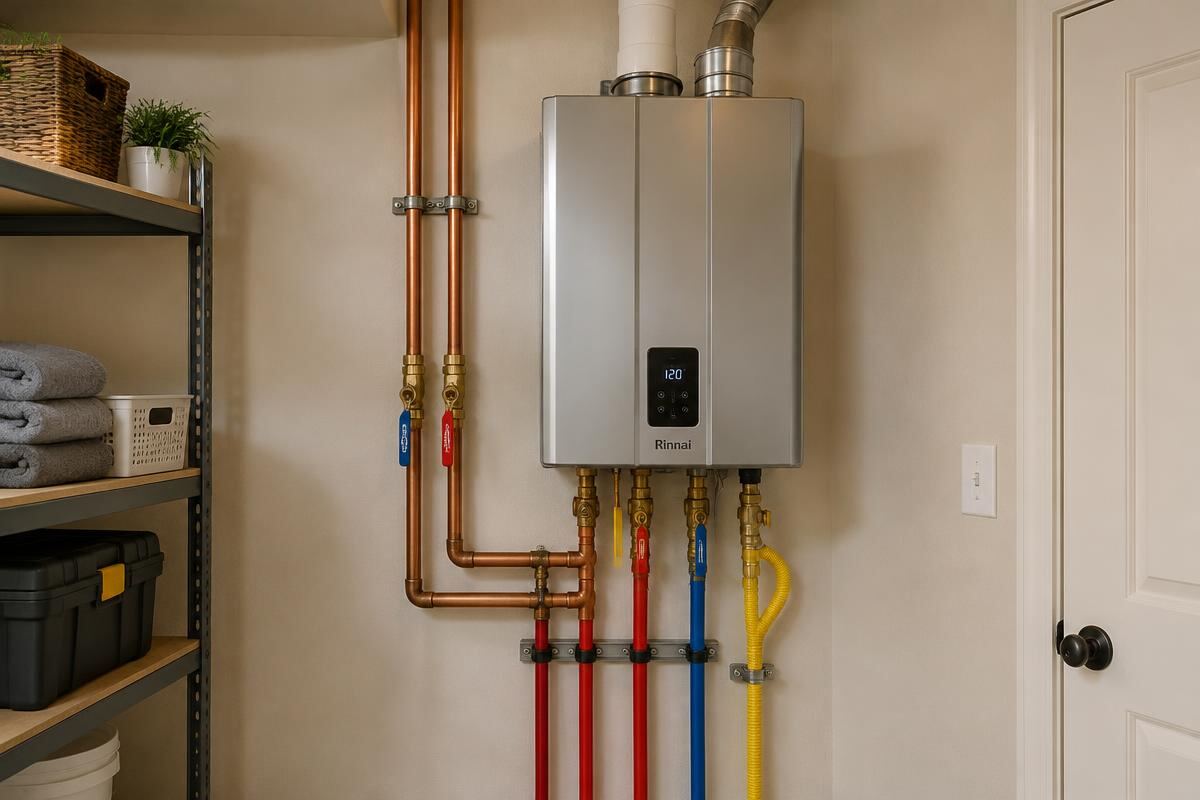
Signs you need water heater installation
- No hot water, or hot water that runs out quickly
- Lukewarm or fluctuating temperatures
- Error codes on a tankless unit
- Rumbling or popping from the tank
- Rusty water or moisture around the base
What is included
- Burner, igniter and venting check
- Descaling and inlet filter cleaning (tankless)
- Anode rod and T&P valve check (tank)
- Error code diagnosis
- Temperature and flow testing
What is not included
- Replacement heat exchangers or tanks (quoted first)
- Water softener installation
- Rental tank removal paperwork with your rental provider
Our process
- 1
Tell us the unit
Tank or tankless, brand and age.
- 2
Diagnose
We test ignition, flow and venting.
- 3
Quote
Clear repair or replacement options.
- 4
Fix and confirm
Work is completed and hot water confirmed at the tap.
Repair or replace?
Tank water heaters usually last 8 to 12 years and tankless units 15 to 20. A leaking tank should be replaced; most tankless issues can be repaired or descaled.
Customer reviews
Sample review for design preview, not a real customer
“Replaced our old tank with a new one. Removal of the old unit was included and they explained the warranty registration process.”
Sample review for design preview, not a real customer
“Our tankless unit was giving lukewarm water. They descaled it and cleaned the inlet filter. Good communication about timing.”
Frequently asked questions
Related services
Nearby areas we serve
Complete guide
A homeowner's guide to water heater installation
If you are looking for water heater installation, this guide explains how the work is done, what usually goes wrong, what it tends to cost and how to choose the right team. It is written for homeowners, not trades, and avoids jargon where possible.
Water Heater Installation starts with planning: the right size and type of water heater, where it goes, how it vents and whether the gas supply can handle it. Getting these right avoids performance problems later.
Your quote lists the equipment, venting, gas work, permits and removal of the old unit if needed, so you can compare options clearly.
How long to expect for water heater installation
Most water heater installation visits take one to two hours once the technician is on site. Straightforward service and common repairs usually finish in a single visit, while jobs needing special-order parts or a permit inspection can stretch over two appointments.
The easiest way to shorten the visit is preparation: have the model and serial number ready, clear access to the water heater and describe the symptoms in the quote form. Technicians can often bring the likely part on the first trip.
Water Heater Installation neighbourhoods
Water heaters vary widely by neighbourhood age: chimney-vented tanks in older Cooksville and Dixie bungalows, power-vented models in 1990s Meadowvale homes, and tankless units in newer Churchill Meadows construction. The venting and gas supply already in place often decide which options are practical.
Water Heater Installation is available city-wide: Applewood, Central Erin Mills, Churchill Meadows, Clarkson, Cooksville, Creditview, Dixie, East Credit, Erin Mills and Erindale, and every neighbourhood around them. Travel time stays short, which helps when the problem cannot wait.
Before the technician arrives
Clear a path to the equipment and about a metre of space around it. Move fragile items, keep pets in another room and let us know about any access codes, parking limits or building rules if you live in a condo or townhouse complex.
If you have past service records, manuals or warranty paperwork, keep them handy. They help the technician understand the history of your water heater.
When to book water heater installation
Every trade has a rush season, and heating and gas work is no different. The first cold snap of fall fills schedules fast, and the first hot week of summer does the same for cooling equipment.
If your water heater installation is not urgent, the quiet weeks between seasons are the easiest time to book. You get more flexible appointment windows and, if a part has to be ordered, the wait matters less.
That said, a water heater showing warning signs should not wait for a convenient month. Small faults grow, and a breakdown in January is harder on everyone than a check in September.
How to choose a water heater installation provider
The right company treats your questions as part of the job, not an interruption. If an answer about your water heater feels evasive, keep looking.
- Ask for a written price before work begins, not just an hourly rate
- Confirm the technician holds the right gas certificate for the work
- Ask whether permits are needed and who arranges them
- Check that old parts can be shown to you on request
- Make sure the company explains repair versus replacement honestly
- Read recent, verifiable reviews from local customers
Warranty questions for water heater installation work
Manufacturer warranties usually expect the equipment to be installed and serviced properly, so keep your invoices and service records. If your water heater is still under warranty, say so when booking, because the process for parts may differ.
We are an independent service company, not a warranty provider. We will tell you honestly when a claim through the manufacturer or installer is your better route.
Repair or replace?
A simple rule many homeowners use: if a repair costs more than half the price of new equipment and the water heater is near the end of its expected life, replacement is usually the better value. If the unit is younger and the fault is a common part, repair almost always wins.
Other things to weigh are efficiency, safety and how much you rely on the equipment. We give you both options with prices when it is a close call, and we will say so when a repair is not worth it.
Mistakes that make water heater problems worse
The most expensive mistake we see is ignoring small changes: a new noise, a slower start, a faint smell. Each one is the water heater telling you something, and the repair is almost always smaller while the symptom is small.
The second mistake is repeated resetting. Turning a unit off and on can clear an error code temporarily, but the fault that caused it is still there, and safety switches that trip repeatedly are doing an important job.
How to avoid repeat water heater installation calls
Tankless heaters need descaling, often yearly, because Lake Ontario water carries minerals that coat the heat exchanger. Cleaning the inlet filter and checking venting are part of the same visit.
Flushing a tank once a year removes sediment that reduces efficiency and causes noise. Checking the anode rod every few years can extend tank life. The temperature and pressure relief valve should also be tested.
Homeowners often ask what they can safely do themselves. The honest answer: keep the area around the water heater clear and clean, follow the owner's manual for basic care, and leave anything involving gas, combustion or internal parts to a certified technician.
Pricing for water heater installation
Homeowners often ask for a price over the phone, and honest companies resist giving one. Two water heaters with the same symptom can need very different repairs, so a phone quote is usually a guess. As a general guide, water heater installation tends to run $1,500 to $3,500, averaging around $2,500, with the final price confirmed after assessment.
Your written quote separates parts and labour and lists anything extra, such as permits or disposal. Nothing is added later without your approval, and HST is shown on the final invoice.
If you are comparing quotes, make sure each one covers the same scope: diagnosis, parts, labour, testing and cleanup. A cheaper quote that excludes testing can cost more in the end.
Comparing quotes without the guesswork
When you collect quotes for water heater installation, compare scope, not just the bottom line: diagnosis, parts, labour, testing, permits and cleanup should all be spelled out. A low number that leaves half of these out is not actually the low number.
A second opinion is always reasonable, especially on a big repair. Any company confident in its diagnosis will not mind you checking it.
Common problems that lead to water heater installation
A water heater rarely fails without warning. These are the symptoms that bring local homeowners to us, and most of them are cheaper to fix early than late.
If you recognize one of these on your water heater, note when it happens and what else was running at the time. Patterns like "only on cold mornings" or "only when several appliances run together" are valuable clues that can shorten the diagnosis.
- The power vent fan runs but the burner never fires
- Not enough hot water for back-to-back showers
- Hot water that smells musty after a vacation
- A rotten egg smell in the hot water
- Hot water pressure lower than cold
- Water pooling around the base of the tank
- Pilot will not stay lit or the power vent fan will not start
- Tankless unit shows an error code or shuts off mid-shower
How a water heater works
Water quality matters here. water carries enough mineral content that sediment builds in tanks and scale coats tankless heat exchangers, which is why flushing and descaling are real maintenance items rather than optional extras.
Tank water heaters store hot water and keep it at temperature with a gas burner under the tank. A thermostat and gas valve control the burner, a flue carries exhaust out, and an anode rod inside the tank slows corrosion. Many homes have power-vented tanks with a small fan on top.
One thing worth knowing about your water heater: most failures give warning signs weeks before a full breakdown. Unusual noises, longer run times and small changes in performance are the equipment asking for attention, and responding early almost always costs less than waiting for a complete stop.
What to expect when we arrive
Every visit follows the same basic shape: listen first, test second, repair third. Skipping the first two steps is how homeowners end up paying for parts they did not need, so we do not skip them.
Testing on a water heater can involve pressure readings, electrical checks on sensors and controls, venting inspection and a full operating cycle. The technician explains each finding as it happens, and you can ask questions at any point.
Nothing is done without your approval. You get the price in writing first, options when there is more than one way to solve the problem, and honest advice if the water heater is not worth repairing. The work area is left clean when we go.
Questions worth asking your technician
Good questions get good answers. Ask what failed and why, what else was close to failing, what the repair prevents and what could have prevented the failure. A technician who welcomes these questions is one worth keeping.
Also ask what to watch for in the weeks after the visit. Every repair has a short list of signs that would mean something related is developing, and knowing them costs nothing.
Getting more from the energy you pay for
A well-maintained water heater uses less energy than a neglected one, and the difference shows up on your utility bill. Clean burners, good airflow and correct settings are not luxuries; they are the difference between the efficiency on the rating plate and the efficiency you actually get.
If your gas or electricity use has crept up without a change in habits, the equipment is a reasonable place to look. A service visit can confirm whether performance has drifted.
Condo and townhouse notes
Condo and townhouse owners have extra logistics: booking elevators, arranging parking, and sometimes getting property management approval before work starts. Mention your building when you request a quote so these are planned for rather than discovered on the day.
Some buildings also have shared systems. If your equipment connects to shared venting or mechanical rooms, your property manager may need to be involved, and it is better to know that before booking.
What to watch for after your water heater installation
Most homeowners forget the details of a repair within weeks, so take thirty seconds to save the invoice and notes somewhere you will find them. Future you, and any future technician, will be glad you did.
Over the following days, use the water heater normally. If performance feels different from before the visit, better or worse, that is useful information and worth passing on.
What is included on every visit
- A technician who works on water heaters regularly
- A written price before any work begins
- Plain-language notes on what was found and fixed
- Honest advice on repair versus replacement
- Tidy work areas and protected floors
Safety notes worth reading
A gas water heater needs clear space around the burner and a clear vent path. Scorch marks, a gas smell or soot near the unit mean stop using it and call for service, and paint, solvents and storage boxes should never crowd the heater.