
Signs you need wood burning fireplace inspection
- Smoke backs into the room when the fire is lit
- Strong, campfire-like smell in warm or humid weather
- Cracked or crumbling firebrick or refractory panels inside the firebox
- Damper is stuck, loose or will not close fully
- Black, flaky or tar-like creosote deposits inside the firebox
- The fireplace has not been used or inspected in years
What is included
- Visual inspection of the firebox, damper and smoke chamber
- Check of the hearth, surround and clearances
- Condition report on the flue and chimney where accessible
- Clear written notes on what we found and any recommended work
What is not included
- Masonry repointing, crown or chimney rebuilding
- Chimney liner replacement (quoted separately)
- Wood to gas conversion (quoted separately as a gas job)
Our process
- 1
Tell us what you see
Share the age of the fireplace, how often it is used and any smoke or odour issues.
- 2
On-site inspection
We check the firebox, damper, smoke chamber and accessible flue for damage and buildup.
- 3
Clear options
You get a written summary of what is safe to use, what needs repair and what it would cost.
- 4
Repair and verify
Approved work is completed and the fireplace is checked before we leave.
Repair or replace?
Most wood-burning fireplace problems are repairable: firebrick panels, dampers, doors and screens are common parts. When the firebox structure itself is failing or you want the convenience of gas, converting to a gas insert is often the better long-term option, and we can quote both paths.
Customer reviews
Sample review for design preview, not a real customer
“Birds had nested in the flue. They cleared it safely, installed a cap and checked draft before we used the fireplace again.”
Sample review for design preview, not a real customer
“Booked a sweep before the first cold week. Clean, careful work with drop sheets everywhere and a clear photo report afterwards.”
Frequently asked questions
Related services
Nearby areas we serve
Complete guide
Wood Burning Fireplace Inspection: what to know
Most people search for wood burning fireplace inspection when something has already gone wrong, or when they want to get ahead of a problem before the season starts. Either way, this guide gives you the full picture: how your wood burning fireplace works, what fails, how we approach the job and how pricing works.
Wood Burning Fireplace Inspection gives you a clear picture of the condition of your wood burning fireplace. You get written notes on what was checked, what passed and anything that needs attention.
Inspections are useful before buying or selling a home, after a renovation, or when a wood burning fireplace has not been used for a long time.
Comparing quotes without the guesswork
When you collect quotes for wood burning fireplace inspection, compare scope, not just the bottom line: diagnosis, parts, labour, testing, permits and cleanup should all be spelled out. A low number that leaves half of these out is not actually the low number.
A second opinion is always reasonable, especially on a big repair. Any company confident in its diagnosis will not mind you checking it.
Timing for a typical wood burning fireplace inspection job
Homeowners often ask whether they need to take a day off work for wood burning fireplace inspection. For most visits, no: the work itself is usually one to two hours, and a morning or afternoon arrival window is enough.
Larger jobs are different. Work involving permits, inspections or ordered parts follows the supplier and inspector schedules, and your quote will spell out the expected timeline before you approve anything.
Choosing the right company for wood burning fireplace inspection
The right company treats your questions as part of the job, not an interruption. If an answer about your wood burning fireplace feels evasive, keep looking.
- Ask for a written price before work begins, not just an hourly rate
- Confirm the technician holds the right gas certificate for the work
- Ask whether permits are needed and who arranges them
- Check that old parts can be shown to you on request
- Make sure the company explains repair versus replacement honestly
- Read recent, verifiable reviews from local customers
If your equipment is getting old
Age changes the questions, not necessarily the answer. On an older wood burning fireplace, we weigh the cost of the repair against the remaining realistic life, the availability of parts and whether efficiency losses are costing you every month.
Discontinued models deserve special mention: some parts are still made, some are available aftermarket and some are simply gone. We check availability before recommending a repair on older equipment.
Before the technician arrives
Before we arrive, gather anything that tells the story of your wood burning fireplace: the model and serial number if you can find them, previous invoices, and notes about what the equipment has been doing.
Plan for access and parking, especially in condos and townhomes where entry needs booking or a fob. The smoother the arrival, the more of the visit goes to actual diagnosis and repair.
Best time of year for wood burning fireplace inspection
Every trade has a rush season, and heating and gas work is no different. The first cold snap of fall fills schedules fast, and the first hot week of summer does the same for cooling equipment.
If your wood burning fireplace inspection is not urgent, the quiet weeks between seasons are the easiest time to book. You get more flexible appointment windows and, if a part has to be ordered, the wait matters less.
That said, a wood burning fireplace showing warning signs should not wait for a convenient month. Small faults grow, and a breakdown in January is harder on everyone than a check in September.
Wood Burning Fireplace Inspection near you
Many older homes in Mineola, Port Credit, Cooksville and Lorne Park still have original brick chimneys, while newer subdivisions usually have factory-built metal flues inside a framed chase. Both need cleaning and inspection, but they fail in different ways and use different replacement parts.
We provide wood burning fireplace inspection, including Erin Mills, Erindale, Fairview, Hurontario, Lakeview, Lisgar, Lorne Park, Malton, Meadowvale and Meadowvale Village. If your neighbourhood is not listed, ask anyway; we cover the whole city.
Maintenance tips to prevent future wood burning fireplace inspection
Burning dry, seasoned hardwood and keeping fires hot enough to draft well both reduce creosote. Small, smouldering fires that burn overnight are one of the most common causes of heavy buildup.
Keep tree branches trimmed back from the chimney top and check the cap after major windstorms. Both are cheap prevention compared to water or blockage damage.
A simple habit that pays off: once a month during the season, take a minute to look at and listen to your wood burning fireplace while it runs. You know what normal looks and sounds like for your own equipment, which makes you the best early-warning system it has.
When wood burning fireplace inspection can wait, and when it cannot
Not every fault is an emergency, and treating them all as one leads to stressed decisions. The clear emergencies involve safety: gas smells, carbon monoxide alarms and anything scorched or smoking. Comfort problems can usually wait a day or two for a proper assessment.
If the equipment still runs, note what it is doing and book a regular visit. If it involves gas, smoke or a safety alarm, follow the safety steps on this page first.
Habits that shorten the life of a wood burning fireplace
Blocking vents and air intakes is a quiet problem. Furniture, storage, snow and landscaping can all restrict the airflow a wood burning fireplace needs to run safely, and the damage builds slowly enough that nobody notices until performance drops.
Another common one is skipping routine care for years and then expecting a single visit to undo it. Maintenance works best as a habit, not a rescue.
What happens during a wood burning fireplace inspection visit
Every visit follows the same basic shape: listen first, test second, repair third. Skipping the first two steps is how homeowners end up paying for parts they did not need, so we do not skip them.
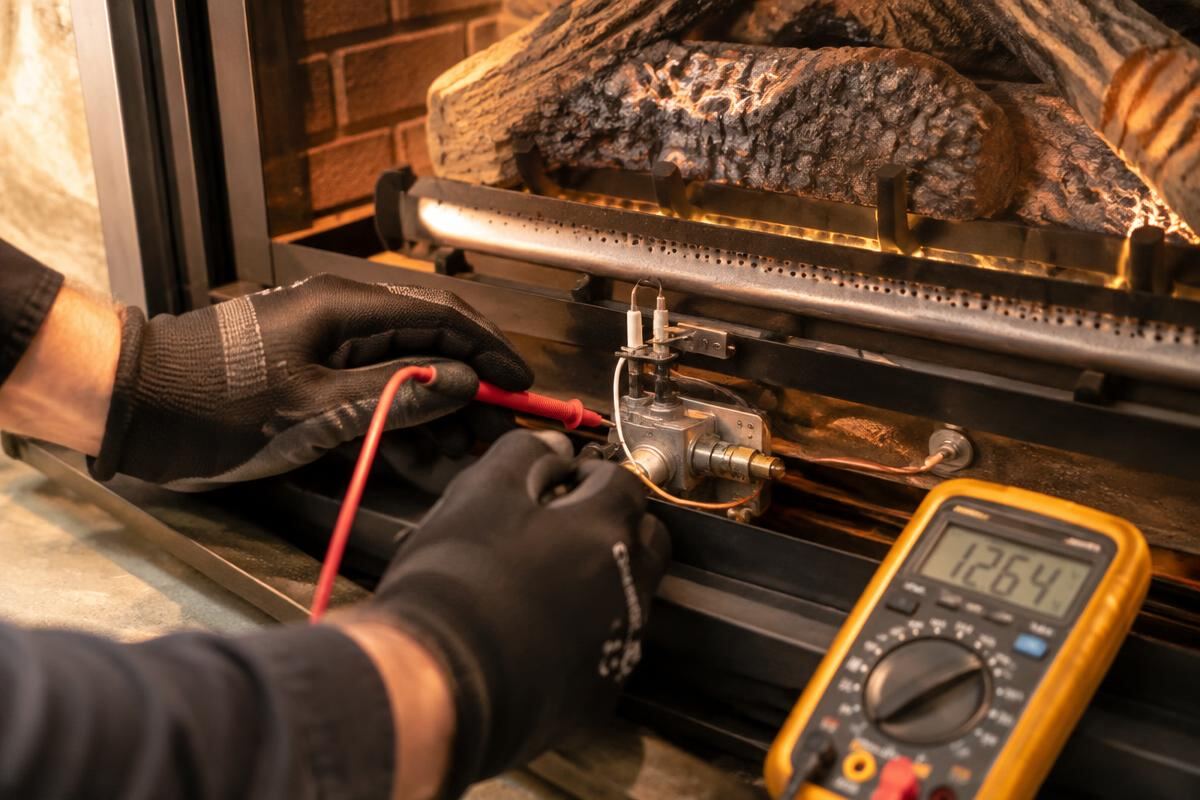
Testing on a wood burning fireplace can involve pressure readings, electrical checks on sensors and controls, venting inspection and a full operating cycle. The technician explains each finding as it happens, and you can ask questions at any point.
Nothing is done without your approval. You get the price in writing first, options when there is more than one way to solve the problem, and honest advice if the wood burning fireplace is not worth repairing. The work area is left clean when we go.
Warranties and paperwork
Before approving a big repair, check whether the part is still covered. Many manufacturers warrant major components far longer than the labour coverage, and a five-minute check of your paperwork can save real money.
Ask for the warranty terms on any new part in writing: what is covered, for how long, and what the claim process looks like.
How a wood burning fireplace works
A chimney does two jobs: it carries smoke and combustion gases out of the home and it creates the draft that pulls fresh air into the fire. When either job fails, smoke spills into the room, the fire struggles and dangerous byproducts can linger.
Draft depends on more than the flue. A chimney that is too short, a cold exterior flue, or a tightly sealed house competing with kitchen and bathroom fans can all cause smoke to spill. Solving smoke problems sometimes means addressing house air pressure, not just the chimney.
One thing worth knowing about your wood burning fireplace: most failures give warning signs weeks before a full breakdown. Unusual noises, longer run times and small changes in performance are the equipment asking for attention, and responding early almost always costs less than waiting for a complete stop.
Deciding between repair and replacement
A simple rule many homeowners use: if a repair costs more than half the price of new equipment and the wood burning fireplace is near the end of its expected life, replacement is usually the better value. If the unit is younger and the fault is a common part, repair almost always wins.
Other things to weigh are efficiency, safety and how much you rely on the equipment. We give you both options with prices when it is a close call, and we will say so when a repair is not worth it.
What wood burning fireplace inspection costs
The estimated range for wood burning fireplace inspection is $150 to $300, with many jobs averaging around $230. This is an estimated range based on typical market prices, and your final price is confirmed after assessment.
The main things that move the price are the age and type of the wood burning fireplace, the parts needed, access (tight spaces, finished ceilings or rooftop work take longer), and whether permits or inspections are required. HST is added to the final invoice.
To get an accurate quote quickly, send the make and model, a photo of the unit and its rating plate, and a short description of the problem. You can use the quote form on this page or try our online price estimator for a starting range.
What to ask during the visit
Good questions get good answers. Ask what failed and why, what else was close to failing, what the repair prevents and what could have prevented the failure. A technician who welcomes these questions is one worth keeping.
Also ask what to watch for in the weeks after the visit. Every repair has a short list of signs that would mean something related is developing, and knowing them costs nothing.
What to watch for after your wood burning fireplace inspection
Most homeowners forget the details of a repair within weeks, so take thirty seconds to save the invoice and notes somewhere you will find them. Future you, and any future technician, will be glad you did.
Over the following days, use the wood burning fireplace normally. If performance feels different from before the visit, better or worse, that is useful information and worth passing on.
Signs your wood burning fireplace needs attention
These are the issues we see most often when homeowners ask about wood burning fireplace inspection. Several can share the same root cause, which is why testing comes before replacing parts.
It is tempting to ignore an intermittent fault, but intermittent problems on a wood burning fireplace tend to become permanent ones at the worst possible time. A check while the symptom is still mild is usually a shorter, cheaper visit.
- Bits of cement or crown coating in the firebox after rain
- Smoke backs into the room when you light a fire
- Black flakes or crumbly deposits falling into the firebox
- Water stains on the ceiling or wall next to the chimney
- Crumbling mortar, loose bricks or white staining on the outside
- Animals, nests or debris in the flue
- Furnace or water heater venting problems traced to the chimney
- Rattling or buzzing sounds on windy days
What is included on every visit
- Respect for your home: floor protection and a clean work area
- Straight answers about your wood burning fireplace, including when repair is not worth it
- Options explained in plain language, not trade jargon
- Written pricing approved by you before any repair
- Follow-up notes so you know exactly what was done
A word on safety
Never burn treated wood, painted offcuts or household garbage. They produce hotter, dirtier fires and corrosive residues that damage the liner and raise creosote risk.