
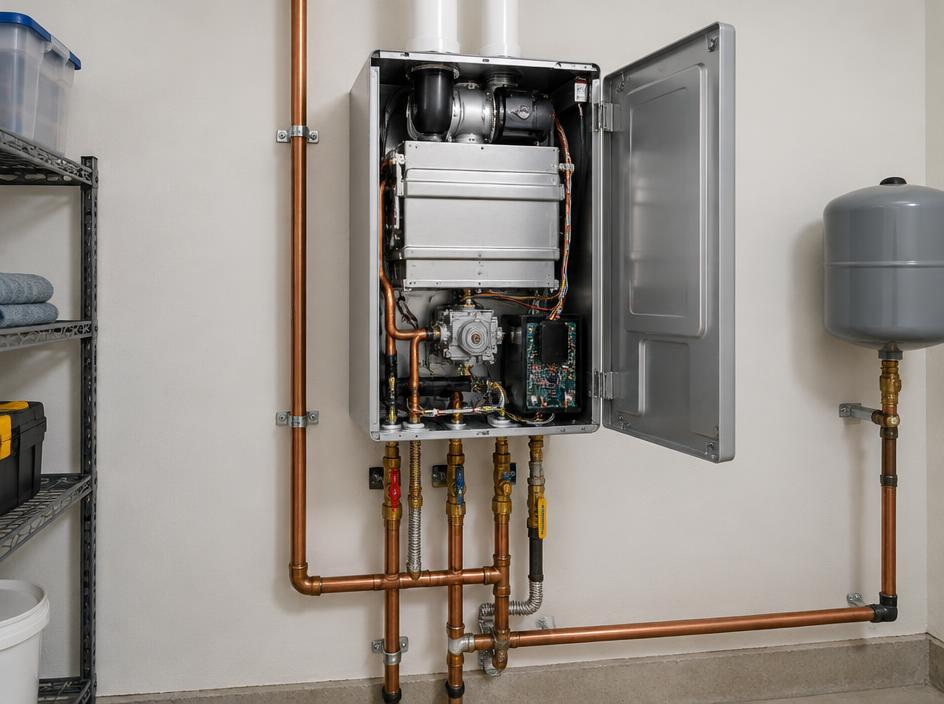
Signs you need tankless repair
- No hot water, or hot water that runs out quickly
- Lukewarm or fluctuating temperatures
- Error codes on a tankless unit
- Rumbling or popping from the tank
- Rusty water or moisture around the base
What is included
- Burner, igniter and venting check
- Descaling and inlet filter cleaning (tankless)
- Anode rod and T&P valve check (tank)
- Error code diagnosis
- Temperature and flow testing
What is not included
- Replacement heat exchangers or tanks (quoted first)
- Water softener installation
- Rental tank removal paperwork with your rental provider
Our process
- 1
Tell us the unit
Tank or tankless, brand and age.
- 2
Diagnose
We test ignition, flow and venting.
- 3
Quote
Clear repair or replacement options.
- 4
Fix and confirm
Work is completed and hot water confirmed at the tap.
Repair or replace?
Tank water heaters usually last 8 to 12 years and tankless units 15 to 20. A leaking tank should be replaced; most tankless issues can be repaired or descaled.
Customer reviews
Sample review for design preview, not a real customer
“Replaced our old tank with a new one. Removal of the old unit was included and they explained the warranty registration process.”
Sample review for design preview, not a real customer
“Our tankless unit was giving lukewarm water. They descaled it and cleaned the inlet filter. Good communication about timing.”
Frequently asked questions
Related services
Nearby areas we serve
Complete guide
Tankless Repair: what to know
If you are looking for tankless repair, this guide explains how the work is done, what usually goes wrong, what it tends to cost and how to choose the right team. It is written for homeowners, not trades, and avoids jargon where possible.
Tankless Repair covers diagnosis, service and repair for your tankless. We start by understanding the symptoms, then test the parts most likely to be involved.
You get a clear explanation of what we found and a written price before any work begins, so you stay in control of the decision.
Timing for a typical tankless repair job
Homeowners often ask whether they need to take a day off work for tankless repair. For most visits, no: the work itself is usually one to two hours, and a morning or afternoon arrival window is enough.
Larger jobs are different. Work involving permits, inspections or ordered parts follows the supplier and inspector schedules, and your quote will spell out the expected timeline before you approve anything.
Warranties and paperwork
Before approving a big repair, check whether the part is still covered. Many manufacturers warrant major components far longer than the labour coverage, and a five-minute check of your paperwork can save real money.
Ask for the warranty terms on any new part in writing: what is covered, for how long, and what the claim process looks like.
Tankless Repair near you
Houses range from older bungalows with chimney-vented tanks in Cooksville and Dixie to newer homes in Churchill Meadows with power-vented or tankless units. Venting type, gas line size and space all affect which repair or replacement makes sense.
We provide tankless repair, including Malton, Meadowvale, Meadowvale Village, Mineola, Mississauga Valleys, Port Credit, Rathwood, Rockwood Village, Sheridan and Streetsville. If your neighbourhood is not listed, ask anyway; we cover the whole city.
Keeping records that pay off later
Take a photo of the rating plate on your tankless and keep it with your records. Model and serial numbers are the first thing any technician or parts supplier will ask for, and they are rarely in a convenient spot.
Note the date of each service visit and set a reminder for the next one. Most tankless care runs on a yearly cycle, and a reminder is the cheapest maintenance tool there is.
Timing your tankless repair around the seasons
Timing affects both availability and cost of waiting. During peak season, appointment slots fill days ahead and parts suppliers run leaner. During the off-season, the same tankless repair can often be booked within a day or two.
A sensible rule homeowners: heating equipment gets checked in early fall, cooling equipment in spring, and anything showing symptoms gets checked now, regardless of the calendar.
If you are reading this because something already failed, do not worry about timing. Send the details through the quote form and we will give you a realistic answer about how soon we can attend.
Efficiency and your gas bill
Efficiency losses are usually gradual, which is why they go unnoticed. A tankless that runs a little longer each cycle costs a little more each month, and over a few years the drift adds up to real money.
Regular maintenance keeps equipment close to its rated performance. When replacement time comes, the efficiency jump from older equipment to new is often large enough to factor into the decision.
Once the technician leaves
If something does not seem right after the work, contact us rather than adjusting the tankless yourself. Describing exactly what changed since the visit helps us respond quickly and accurately.
It also helps to note the date of the visit. Many maintenance tasks work on a yearly cycle, and a reminder set for the same month next year keeps the tankless on a sensible schedule.
Choosing the right company for tankless repair
The right company treats your questions as part of the job, not an interruption. If an answer about your tankless feels evasive, keep looking.
- Ask for a written price before work begins, not just an hourly rate
- Confirm the technician holds the right gas certificate for the work
- Ask whether permits are needed and who arranges them
- Check that old parts can be shown to you on request
- Make sure the company explains repair versus replacement honestly
- Read recent, verifiable reviews from local customers
What to expect when we arrive
When the technician arrives, the first step is protecting your home: floor coverings where needed, and a tidy work area around the tankless. Then come the questions. What you have seen, heard or smelled, and when it started, often matters more than any single test.
Diagnosis is done in a set order. We confirm the symptom, test the parts most likely to cause it and only then talk about repairs. You are shown what was found, in plain language, before anything is taken apart or replaced.
You approve a written price before work begins, and old parts are left with you on request. Once the repair is done, the tankless is run through a full cycle to confirm the fix, and you get a summary of the work for your records.
Deciding between repair and replacement
A simple rule many homeowners use: if a repair costs more than half the price of new equipment and the tankless is near the end of its expected life, replacement is usually the better value. If the unit is younger and the fault is a common part, repair almost always wins.
Other things to weigh are efficiency, safety and how much you rely on the equipment. We give you both options with prices when it is a close call, and we will say so when a repair is not worth it.
What to ask during the visit
You do not need technical knowledge to interview your technician. "What did you find?", "What are my options?" and "What would you do if it were your house?" cover most of what matters.
Write the answers down or ask for them in the visit notes. When the next decision about your tankless comes up, you will be glad you did.
How to avoid repeat tankless repair calls
Flushing a tank once a year removes sediment that reduces efficiency and causes noise. Checking the anode rod every few years can extend tank life. The temperature and pressure relief valve should also be tested.
Tankless heaters need descaling, often yearly, because Lake Ontario water carries minerals that coat the heat exchanger. Cleaning the inlet filter and checking venting are part of the same visit.
Homeowners often ask what they can safely do themselves. The honest answer: keep the area around the tankless clear and clean, follow the owner's manual for basic care, and leave anything involving gas, combustion or internal parts to a certified technician.
Habits that shorten the life of a tankless
Blocking vents and air intakes is a quiet problem. Furniture, storage, snow and landscaping can all restrict the airflow a tankless needs to run safely, and the damage builds slowly enough that nobody notices until performance drops.
Another common one is skipping routine care for years and then expecting a single visit to undo it. Maintenance works best as a habit, not a rescue.
Signs your tankless needs attention
These are the issues we see most often when homeowners ask about tankless repair. Several can share the same root cause, which is why testing comes before replacing parts.
Keep in mind that the same symptom can have different causes on different models of tankless. That is why we diagnose rather than guess, and why a written price comes after testing, not before.
- A rotten egg smell in the hot water
- No hot water, or hot water runs out much faster than before
- Water pooling around the base of the tank
- Hot water that smells musty after a vacation
- The power vent fan runs but the burner never fires
- Pilot will not stay lit or the power vent fan will not start
- Rumbling or popping from a tank as sediment builds up
- Tankless unit shows an error code or shuts off mid-shower
How a tankless works
Tank water heaters store hot water and keep it at temperature with a gas burner under the tank. A thermostat and gas valve control the burner, a flue carries exhaust out, and an anode rod inside the tank slows corrosion. Many homes have power-vented tanks with a small fan on top.
Venting type decides what replacement options are practical. A chimney-vented tank can often be swapped like-for-like, while switching to power vent or tankless means new venting and often a gas line upgrade, which changes the project cost.
The details vary by model, but the pattern holds across tanklesss homes: a small wear part usually fails first, and catching it early keeps the repair small. That is why we test the cheap, common failures before the expensive ones, and why a symptom that seems minor is still worth a call.
What tankless repair costs
The estimated range for tankless repair is $200 to $600, with many jobs averaging around $400. This is an estimated range based on typical market prices, and your final price is confirmed after assessment.
The main things that move the price are the age and type of the tankless, the parts needed, access (tight spaces, finished ceilings or rooftop work take longer), and whether permits or inspections are required. HST is added to the final invoice.
To get an accurate quote quickly, send the make and model, a photo of the unit and its rating plate, and a short description of the problem. You can use the quote form on this page or try our online price estimator for a starting range.
How to get ready for the visit
A few minutes of preparation makes the visit faster. Make sure the tankless is reachable, the area around it is clear and an adult is home to approve the written price before work begins.
Write down the symptoms you have noticed and when they started. If the problem comes and goes, a short video on your phone can be more useful than any description.
When tankless repair can wait, and when it cannot
Not every fault is an emergency, and treating them all as one leads to stressed decisions. The clear emergencies involve safety: gas smells, carbon monoxide alarms and anything scorched or smoking. Comfort problems can usually wait a day or two for a proper assessment.
If the equipment still runs, note what it is doing and book a regular visit. If it involves gas, smoke or a safety alarm, follow the safety steps on this page first.
How we handle every job
- Diagnosis first, parts second: we test before we replace
- Upfront written pricing you approve before work starts
- Familiarity with the tanklesss common homes
- Old parts shown or left with you on request
- A clear summary of the work for your records
A word on safety
Water heaters burn gas and must vent properly. If you smell gas or see scorching near the burner access, stop using the heater and call for service. Keep storage and flammable products away from the unit.