
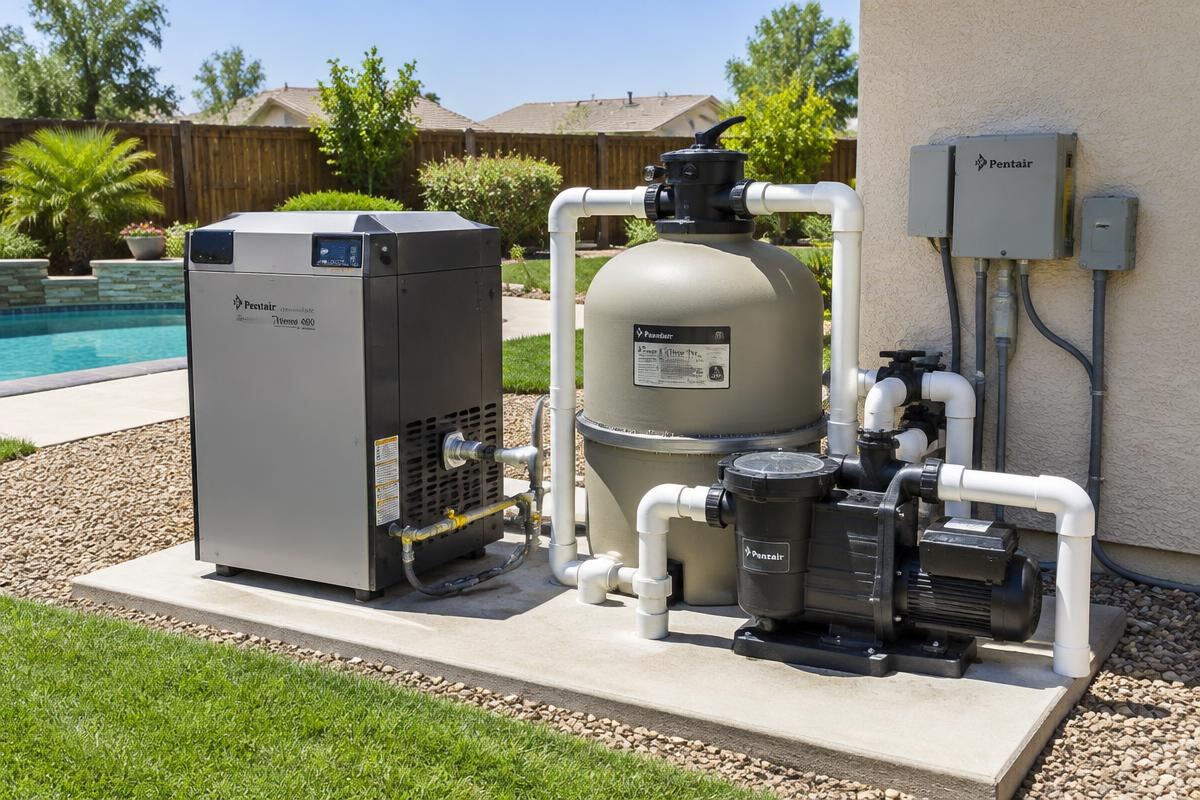
You opened the pool, filled it, balanced the water and turned on the heater, and the water temperature has barely moved. Or the heater ran fine last weekend and now it clicks, shows an error code and refuses to fire. A pool heater not heating is a frustrating start to the swimming season, especially where the warm months are short and every swim day counts.
Gas pool heaters are reliable machines, but they live outdoors, sit idle for months and depend on good water flow and clean combustion. When one stops heating, the cause is often a flow, sensor or ignition problem rather than a dead heater. This guide covers how a pool heater works, the most common causes, safe checks you can do, what a pool heater repair visit involves, cost factors and how to avoid the problem next season.
How a gas pool heater works
A gas pool heater takes water from the pump and filter, passes it through a heat exchanger above a gas burner, and returns warmer water to the pool. A control board manages the sequence: it checks for water flow through a pressure switch, confirms the venting, lights the burner with a hot surface igniter or spark, and proves the flame with a sensor.
Several safety switches are in the circuit, including high-limit switches that prevent overheating. If any of these switches is open, the board will not allow the burner to fire. That is why a heater can look completely fine on the outside and still refuse to heat. Most brands, including Hayward, Pentair, Raypak and Jandy, use a similar logic with their own error codes.
Common reasons a pool heater won't heat
The usual causes fall into flow, ignition, gas and environmental problems. Here is what we see most often backyards.
- Low water flow from a dirty filter, clogged skimmer or pump basket, or closed valve, which keeps the pressure switch open.
- Pump running at too low a speed on a variable-speed pump to satisfy the heater's flow requirement.
- A faulty or out-of-adjustment pressure switch.
- A failed igniter or dirty flame sensor.
- Insects, spiders or rodents nesting in the burner tray or venting over the winter.
- Corrosion on the heat exchanger or burners from poor water chemistry.
- Gas supply problems, including a closed valve or an undersized gas line.
- A tripped high-limit switch from scale buildup or restricted flow.
- Control board or thermostat failure, often after moisture exposure.
What you can safely check first
These checks focus on water flow and settings. They do not involve opening the heater cabinet or touching gas parts.
- Clean the skimmer and pump baskets and backwash or clean the filter.
- Confirm all valves between the pump and the heater are open and the heater is not bypassed.
- On a variable-speed pump, run a higher speed during heating to see if the heater fires.
- Check that the heater is set to POOL or SPA as intended and that the setpoint is above the current water temperature.
- Make sure the heater has power and the breaker is on.
- Look around the heater for leaves, grass clippings or debris blocking airflow or vents.
- Note any error code or message on the display.
If the heater still will not heat, leave the cabinet closed and call a technician. Please do not clear burners, bypass switches or try to adjust gas parts. If you smell gas near the pool equipment, move away from the area and call the gas utility emergency line and 911.
Why water chemistry matters for your heater
Many pool heater failures start with water chemistry. Water that is too acidic eats away at copper heat exchangers. Water that is too hard or high in calcium leaves scale inside the tubes, which reduces heat transfer and causes the heater to overheat and trip. Salt systems, chlorine feeders placed upstream of the heater, and poorly balanced water all shorten heater life.
Keeping pH, alkalinity and calcium hardness in the recommended range, and making sure chemical feeders are installed after the heater, is one of the cheapest ways to protect a heater worth thousands of dollars.
What a pool heater repair visit includes
Our technicians start by confirming flow and reading the heater's error history. They test the pressure switch, high limits, igniter, flame sensor, gas valve and control board, check gas pressure at the heater under load, and inspect the burners and heat exchanger for debris, soot, corrosion or scale.
Common repairs include cleaning burners and the burner tray, replacing an igniter or sensor, adjusting or replacing the pressure switch, and clearing pests or debris. After the repair, the heater is run and monitored to confirm a proper temperature rise and safe combustion. If a major part such as the heat exchanger has failed, you get a clear comparison between repair and replacement before deciding.
Pool heater repair cost
Pool heater repair cost depends on the brand, the part involved and the condition of the heater. Cleaning and minor adjustments are at the lower end. Igniters, sensors and switches are mid-range. Control boards, gas valves and heat exchangers are the most expensive.
Our pricing page lists estimated ranges for pool heater repair and service. They are estimated ranges only, and the final price is confirmed after assessment. We confirm pricing before the work begins.
Repair or replace your pool heater?
A heater that is under ten years old with a single failed component is usually worth repairing. When a heater is older, has a leaking or badly scaled heat exchanger, or has needed several repairs in a row, replacement is often better value. A modern heater may also heat faster and be more efficient.
If you are considering replacement, it is worth asking about heater sizing for your pool volume and how you use it. A correctly sized heater heats faster and runs shorter cycles, which can save gas over the season.
Not sure what's causing it?
A technician can diagnose it on the first visit and confirm the price before any work.
Opening and closing tips to avoid problems next year
Many no-heat calls in spring trace back to how the heater was closed the previous fall. Proper pool heater winterization drains water from the heat exchanger so it cannot freeze and crack, and protects the burner area from pests. A cover or screen over vents can help, as long as it is removed before firing.
In spring, a pool heater start-up service checks for pests, cleans burners, verifies gas pressure and tests safety switches before the heater runs for the first time. Booking the start-up a week or two before you plan to swim gives time to fix anything that comes up.
Error codes and what they usually point to
Every brand uses its own codes, but most fall into a few groups. Learning which group your code belongs to helps you describe the problem when you call.
- Pressure switch or flow codes: usually low water flow, dirty filter, pump speed or a faulty switch.
- Ignition or flame failure codes: igniter, flame sensor, gas supply or dirty burners.
- High-limit or overheat codes: scale, restricted flow or a failing limit switch.
- Vent or air codes: blocked vents, pests or inducer problems on certain models.
- Sensor or thermistor codes: a failed temperature sensor or wiring issue.
- Control or communication codes: board failure, moisture or wiring problems.
Write down the exact code and take a photo of the display. Do not reset the heater repeatedly to clear a safety code, since the code is the best clue to what went wrong.
Pests, debris and the outdoor environment
Pool heaters sit outside year round, which makes them attractive to insects, spiders, mice and chipmunks. Over the winter, critters build nests in the burner tray, combustion chamber or venting. When the heater is fired in spring, the nest blocks airflow and causes ignition problems, sooting or even damage to wiring.
Keeping the area around the heater clear of plants, mulch, leaves and stored items helps. So does a proper winterization and a careful start-up inspection. Sprinklers spraying directly on the heater can also cause corrosion and electrical problems, so it is worth adjusting their direction.
Making your heating season more efficient
A pool heater that works properly can still feel expensive to run. Simple habits make a big difference. Using a solar or insulated cover overnight dramatically reduces heat loss. Setting a reasonable temperature and heating before the weekend instead of keeping the pool hot all week saves gas. Running the pump at the right speed for heating, then lowering it, balances heater needs with energy savings.
If your heater is old and you are considering an upgrade, ask about high-efficiency gas heaters and heat pump pool heaters. Each has strengths depending on how early and late in the season you swim, and a technician can help you compare options for your yard.
Pool heater problems in different situations
When and how the heater fails tells you a lot. A heater that will not fire at all after spring opening often has a flow problem, a pest-blocked burner or a closed gas valve. A heater that fires and then shuts off within minutes is often dealing with a dirty flame sensor, a high-limit trip or scale. A heater that runs but the water barely warms may be undersized, losing heat through an uncovered pool, or running with a poor flame.
A heater that works on the spa but not on the pool usually points to a valve position or controller setting. A heater that stops after heavy rain may have moisture in the controls. Describing these patterns when you book pool heater repair helps the technician bring the right parts and fix the heater faster.
Book pool heater repair
If your pool heater is not heating, EmberRise Pro can diagnose and repair most major brands, including Lorne Park, Port Credit, Sheridan and Mississauga Valley. Send a quote request with your heater brand, the error code and what is happening, and our team will confirm availability and pricing.